

If you’re looking up Fortissio reviews before investing your money, you’ve come to the right place. This broker knows how to sell itself well: a license, education, and a personal account manager. We’re about to show you what’s hiding behind this platform and whether it’s even worth going near it, because this might turn out to be a scam.
Brief Overview
- 🖥Official Website: fortissio.com
- ✈️Contact Address: 4, 28th October Street, Marousi, Greece
- 📞Customer Support: info@fortissio.com, +302112340925
- 🔐Licensing and Accreditation: HCMC
- ⏳Track Record: 2017
- 🧰Specialization: brokerage service
- 🤝Terms of Cooperation: $200, 1:20
- 💰Additional Services: economic calendar, autochartist, education, personal manager
Fortissio.com Examination
As usual, let’s start with the official website. It looks standard for a brokerage company. Fortissio uses images pulled from the internet: a logo with a little tower, on the homepage, a man in a gray shirt pointing his finger at a stone tower, or a gray-haired man with a laptop who’s “satisfied with life”.
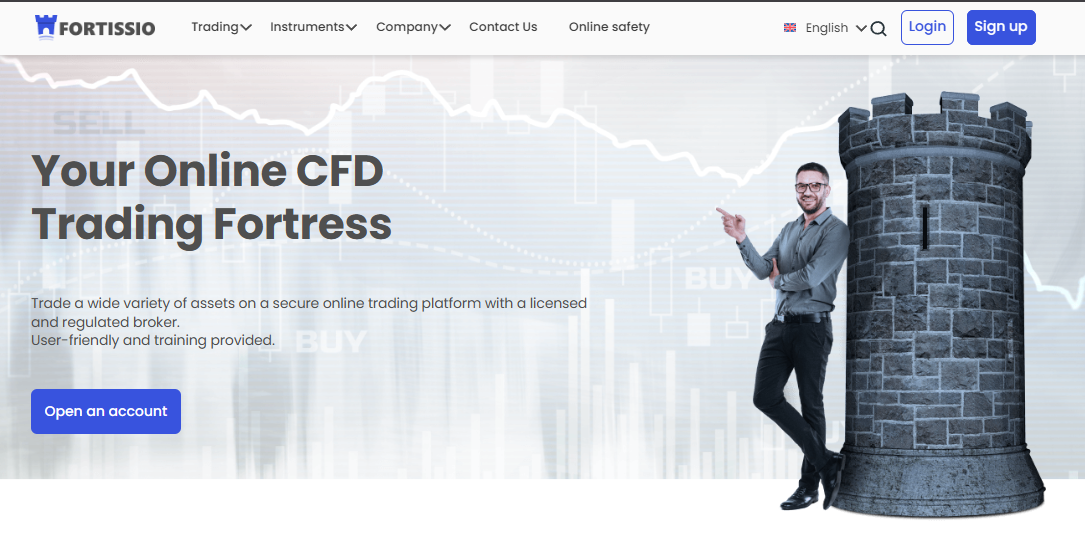
The texts are written smoothly, but with unnecessary content and inconsistencies. The most noticeable one: on the homepage, the broker promises “over 300 assets”, while on the Why Fortissio page, it’s already “over 130 financial instruments”. Two different numbers. And it isn’t an isolated case.
The top menu is standard:
- Trading.
- Instruments.
- Company.
- Contact us.
- Online safety.
There, you can find all the information about the conditions, the platform, the broker, the legal documents, and even some handy tips when it comes to online safety. The company also lists all its legal information, provides a risk warning, and discloses its license. All in all, a typical brokerage website with suspicious elements in the form of inconsistencies, meaningless content for the sake of grandeur and motivation, and images pulled from the internet.
Company Contacts
Fortissio lists its contacts in a fairly detailed fashion: a customer support phone number (operating Monday through Friday, 8:00 a.m. to 8:00 p.m. GMT+2), and a whole set of email addresses for different purposes: general inquiries, complaints, dealing, back office, and support, plus a link to a contact form and a Facebook page. Meanwhile, live chat is, for some reason, absent.
Key Conditions
Instead of the usual two or three account types, like Pepperstone’s Raw/Standard, Fortissio has a whole staircase of 10 levels: Starter, Explorer, Champion, Elite, Luxury, VIP, Prestige, Superior, Infinity, Royal, and Expert. The tier is tied to the deposit size.
Starter is $200–999, and at this level, you get a 0% discount. From there, it ramps up: Explorer ($1,000–4,999) gives you 5%, Champion gives 10%, and so on up to Expert ($200,000 and above), where the discount is 60%. This discount is called the “Price & Rollover Discount” — meaning the bigger the deposit, the less the client pays for the spread and for rolling a position over to the next day.
This is precisely the main bait-and-switch in the conditions. With an honest broker, the spread is the same for everyone — whether the trader has a $100 deposit or $100,000. But here, clients are told, “Want decent conditions? Invest more to reach the next level”. The result is that a beginner with $200 pays full price, while only those with tens of thousands get normal spreads. It’s a direct incentive to put in more money, and the account manager will be applying pressure for it.
Leverage at Fortissio for retail clients is 1:20, while for professional traders it’s 1:200. Spreads depend on the asset and account type, and you can look them up in the detailed contract specifications.
Exposing Fortissio
The broker confidently declares: “We’re regulated, we have oversight across eight European countries”. It sounds as if half the continent has its eye on the company. In reality, there’s only one actual license — the Greek HCMC No. 4/792/20.7.2017. Everything else (Spain, France, Sweden, Norway, Finland, the Netherlands, and Germany) isn’t licenses but notifications.
And here’s where the problem lies. The Greek HCMC is one of the weakest regulators in the EU. It isn’t an offshore on the level of the Comoros Islands, but it’s nowhere near the British FCA or the German BaFin in terms of how hard it bites. The HCMC plainly doesn’t have enough resources to really go after brokers for violations. So the license formally exists, but the oversight of what the broker is doing with your money is weak.
There’s also the harshest fact, which Fortissio is careful not to bring up. The Polish regulator KNF placed Vie Finance on the list of public warnings. You can take a closer look here. The reason was that the company conducted Forex activities in Poland without the proper authorization. What’s more, the KNF filed a complaint of suspected criminal activity under Article 178 of the Polish Act on Trading in Financial Instruments (conducting activities without the required authorization).

Fortissio operates on a 100% B-book scheme — and this is, arguably, the main danger to a trader’s deposit. Here’s what that means in plain language: when a client opens a trade, the broker doesn’t route it to the real market. It takes the other side of the bet itself. The trader clicks “buy” and waits for a rise, while the company is actually betting that they’ll be wrong. The trader’s loss becomes the firm’s profit.
What Reviews Do Users Leave?
When it comes to reviews of Fortissio, the main problem is that the real negativity gets drowned out in positive but fake comments. The genuine complaints are out there — on the same platforms like WikiFX, people are writing the same scenario: the profit gets shown on the screen, but when it comes time to withdraw, the money gets stuck. Meanwhile, the search results get flooded with polished “reviews” that call the broker “safe” simply because they earn a commission for every client they bring in.
Conclusions
Fortissio knows how to put up a pretty front, but behind that prettiness and “fortress” hides a weak regulator, a 100% B-book against the client, and real problems with withdrawals. There isn’t a single reason to risk your money here.
Pros/Cons
- Valid EU license — Greek HCMC (No. 4/792).
- The HCMC has permanently banned Fortissio from operating in Poland (the ban is indefinite and takes effect immediately).
- The Polish Financial Supervision Authority (KNF) has blacklisted the company and filed a criminal complaint (under Article 178).
- 100% B-book business model.
- Fake positive reviews online.



I didn’t enjoy trading here. Let me say right off the bat – the spreads are huge here, which makes day trading unprofitable. I tried for a month, but I just couldn’t earn anything. In the end, I switched companies, and everything turned out fine – I started earning a profit. So I don’t recommend this broker. On top of that, there are stories of people being ripped off. Be careful, this might turn out to be a scam.
Last year, they were actively calling me up and promising me guaranteed earnings. I figured out right away that these were some kind of scammers. There aren’t a whole lot of reviews about them, even though the company has supposedly been around for a while. That’s a bad sign. I never did take the risk of opening an account with Fortissio